


Maintaining a healthy gross margin is essential for reaching the break-even point and sustaining the business. Higher inventory turnover can lower the break-even point by reducing holding costs and increasing cash flow. If a business is at the precise break-even point, the business is neither running at a profit nor at a loss; it has simply broken even.
Is your sales price right?
Tracking this data over time can help you identify patterns — e.g., slower sales during specific months — so you can adjust your strategy based on those trends. The contribution margin is determined by subtracting the variable costs from the price of a product. Break-even analysis helps businesses choose pricing strategies, and manage costs and operations. In stock and options trading, break-even analysis helps determine the minimum price movements required to cover trading costs and make a profit. Traders can use break-even analysis to set realistic profit targets, manage risk, and make informed trading decisions. In contrast to fixed costs, variable costs increase (or decrease) based on the number of units sold.
Limitations of break-even analysis
Break-even analysis looks at fixed costs relative to the profit earned by each additional unit produced and sold. The Break-Even Point (BEP) is the inflection point at which the revenue output of a company is equal to its total costs and starts to generate a profit. For options trading, the breakeven point is the market price that an underlying asset must reach for an option buyer to avoid a loss if they exercise the option.
Kesalahan Umum dalam Menghitung BEP dan Cara Menghindarinya
Our online calculators, converters, randomizers, and content are provided «as is», free of charge, and without any warranty or guarantee. Each tool is carefully developed and rigorously tested, and our content is well-sourced, but despite our best effort it is possible they contain errors. We are not to be held responsible for any resulting damages from proper or improper use of the service.
- While gathering the information you need to calculate your break-even point is tricky and time consuming, you don’t have to crunch the numbers with just a pen and paper.
- If she wants to turn a profit, she’ll need to sell at least nine quilts a month.
- Break-even analysis looks at fixed costs relative to the profit earned by each additional unit produced and sold.
- Fixed expenses, such as rent and salaries, remain constant regardless of sales volume, directly affecting the break-even point.
- But with the right tools, it’s easier to track costs, keep finances in order, and make decisions that will help the company stay profitable.
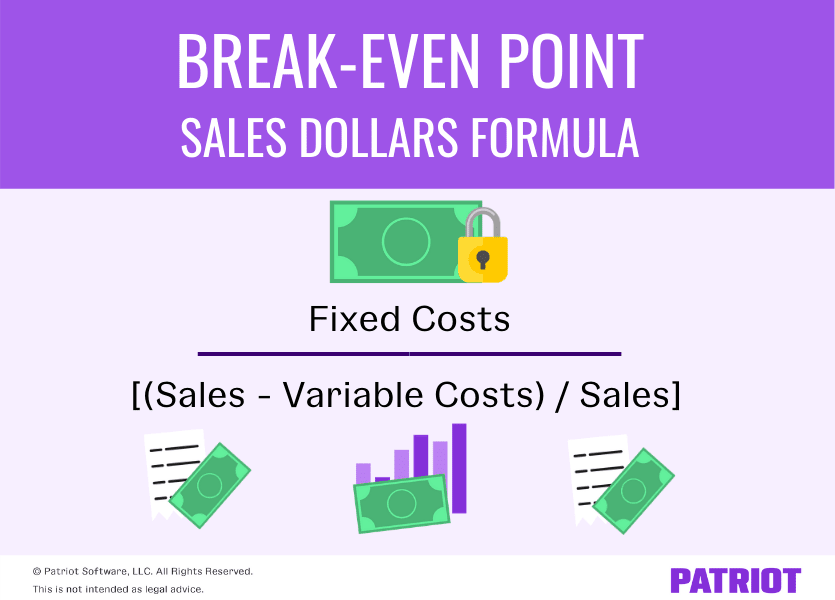
Simply enter your fixed and variable costs, the selling price per unit and the number of units expected to be sold. The denominator of the equation, price minus variable costs, is called the contribution margin. After unit variable costs are deducted from the price, whatever is left—the contribution margin—is available to pay the company’s fixed costs. If the company can increase its contribution margin per unit to $8 (by perhaps lowering its per unit variable cost), it only needs to sell 8,750 ($70,000 / $8) to break even.
Logistics Calculators
Let’s break down these two other components, so you know how to calculate the break-even point. Learn how to build, read, and use financial statements for your business so you my xero for partners can make more informed decisions. If you’re a latecomer to a market, there might be too much supply, and you might not be able to break even without economies of scale.
If you’d rather calculate it manually, below we have described how to calculate the break-even point, and even explained what is the break-even point formula. As you can see, the Barbara’s factory will have to sell at least 2,500 units in order to cover it’s fixed and variable costs. Anything it sells after the 2,500 mark will go straight to the CM since the fixed costs are already covered. Let’s take a look at a few of them as well as an example of how to calculate break-even point.
Andy Smith is a Certified Financial Planner (CFP®), licensed realtor and educator with over 35 years of diverse financial management experience. He is an expert on personal finance, corporate finance and real estate and has assisted thousands of clients in meeting their financial goals over his career. If a company has reached its break-even point, the company is operating at neither a net loss nor a net gain (i.e. “broken even”).
